Intercom vs Zendesk in 2026: The AI Resolution Gap (Fin vs Zendesk AI Compared)
Chris CholetteFounder, CloneDeskMay 20269 min read
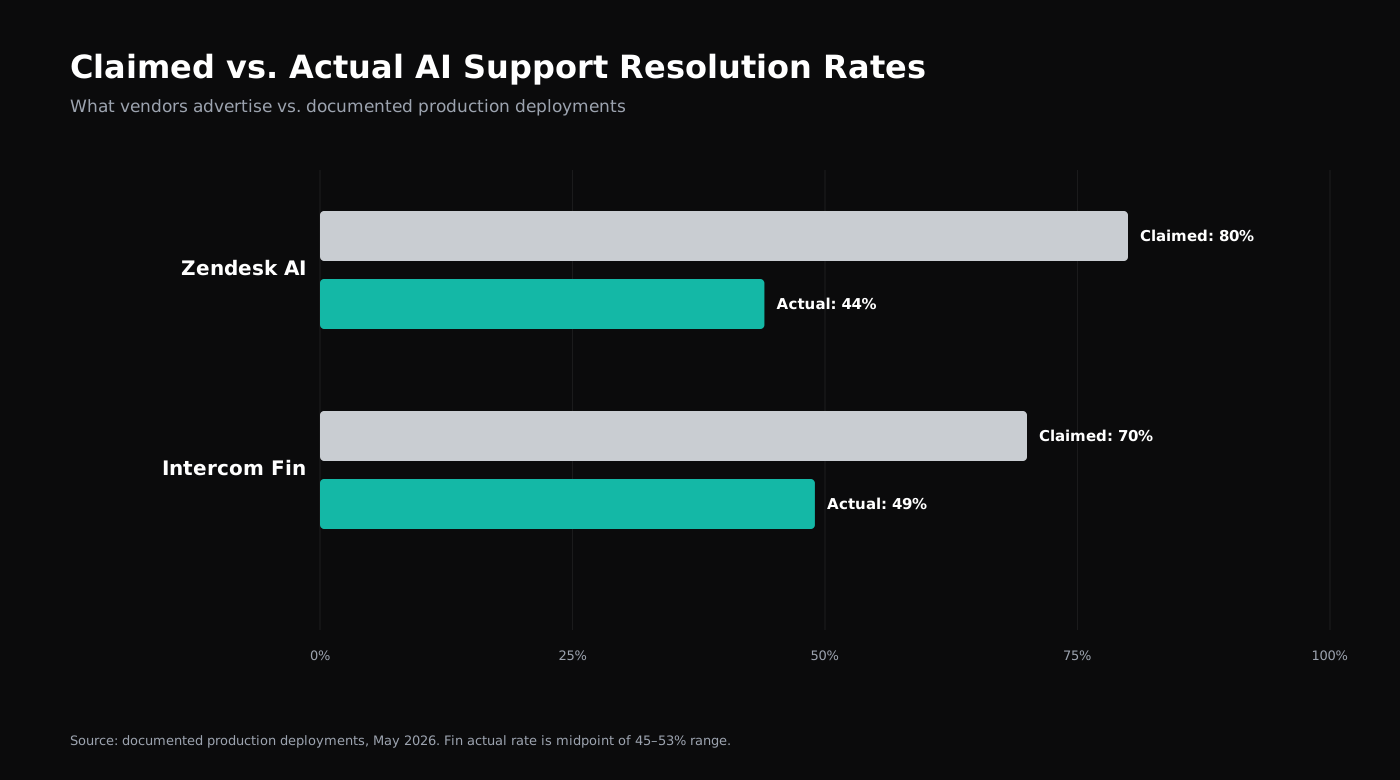
The Intercom vs Zendesk decision in 2026 is no longer about ticketing UX or seat pricing — both platforms ship a mature core helpdesk. It's about AI resolution: which platform's automated agent actually closes tickets without sending them to a human, and at what real cost. Intercom Fin claims a 70% resolution rate; Zendesk AI claims 80%. In production, the documented numbers are 45–53% (Fin) and 44% (Zendesk AI) — a gap of 20 to 36 points between what vendors advertise and what teams actually see. Both tools use the same underlying architecture (RAG), which is the structural reason both underperform in similar ways.
This is a fair, data-backed comparison for heads of support and CX directors choosing between Intercom and Zendesk in 2026. We cover how each is priced, what the production resolution data actually shows, where each breaks down on which ticket types, and what a third option — behavioral fine-tuning — does differently.
TL;DR — Intercom vs Zendesk, 2026 decision
Fin resolves 45–53% in production (vs. 70% claimed); Zendesk AI resolves 44% (vs. 80% claimed). Fin wins on per-resolution pricing (~$0.99/resolution vs. ~$50/agent/month) and multi-language coverage; Zendesk AI wins on native ticketing integration if your team is already on Zendesk Suite. Neither learns from your historical tickets — both use RAG over your knowledge base — and that's the structural reason production resolution lands 20–36 points below vendor claims.
Both vendors fall well short of their advertised numbers once you measure real production deployments — and the gap is widest exactly where teams expect the most.
What changed in 2026
Q1–Q2 2026 brought updated pricing on both platforms and additional production benchmark data, but no change to the underlying architecture: both Intercom Fin and Zendesk AI still retrieve from your documentation at inference time — they don't train on your resolved tickets. The 20–36 point claim-vs-production gap documented through 2025 has held.
How We're Comparing These Tools
Vendor-published resolution rates are marketing numbers. They're real, but they're measured under conditions optimized to show the tool in the best light: well-maintained knowledge bases, simple ticket mixes, internal testing environments, or cherry-picked customer deployments.
Production reality looks different. We're using:
Documented deployments — named companies, published case studies, or publicly disclosed production metrics
Third-party benchmarks — independent evaluation datasets not controlled by either vendor
Vendor pricing pages as of May 2026
One definitional note that matters throughout this comparison: both Zendesk and Intercom define "resolution" as any conversation that closes without a human agent picking it up. A customer who gives up, received a wrong answer, or submitted a second ticket via email is still counted as "resolved." That definition inflates both vendors' numbers — and is part of why the gap to production reality is so large.
Zendesk AI: Features, Pricing, and Actual Resolution Rate
Zendesk AI is Zendesk's native AI layer, branded under the "Zendesk AI" umbrella since their 2023 acquisition of Ultimate. It includes an AI Agent (automated resolution bot), intelligent triage for routing, and macro suggestions for human agents.
What it does well
Zendesk AI integrates natively into an existing Zendesk deployment with minimal configuration overhead. If your team is already on Zendesk Suite, the AI layer connects to your existing knowledge base, ticket history, and macros without a separate implementation project. It handles straightforward FAQ deflection, order status lookups, and returns processing reasonably well when the knowledge base is current and comprehensive.
Pricing
Zendesk AI is priced as an add-on to existing Zendesk Suite seats. The AI Agent capability adds approximately $50 per agent per month on top of existing seat costs. A team of 20 agents on Zendesk Suite Growth (~$115/agent/month) is looking at a total of roughly $165/agent/month, or $3,300/month for the team — before any per-resolution overage.
Actual resolution rate
Vagaro — booking software, ~5M users
Zendesk AI Agent deployment · Vendor-claimed: 80% automation rate
44%
documented resolution
Vagaro is the most widely cited production data point for Zendesk AI. Per Zendesk's own published case study, their AI agent resolved 44% of inquiries — meaning 56% of tickets still required human intervention. Zendesk's own marketing references an 80% automation rate as an aspiration or best-case result. The 36-point gap comes from the ticket mix: Zendesk AI handles simple lookups well, but Vagaro's queue, like most SaaS support queues, is weighted toward the multi-step account and billing issues where RAG struggles.
Independent benchmarks reinforce this pattern. A January 2026 evaluation of enterprise AI support tasks found a best-case success rate of 24% on complex multi-step tickets across leading AI support tools — with simple FAQ tasks scoring much higher and pulling up the averages vendors report.
44%
Zendesk AI's documented production resolution rate (Vagaro) vs. 80% vendor claim
Where it breaks down
Billing disputes and multi-step account issues (typical RAG failure zone)
Tickets that depend on context from previous conversations
Edge cases and policy exceptions not captured in documentation
Any resolution that requires matching your escalation logic rather than a help article
Intercom Fin: Features, Pricing, and Actual Resolution Rate
Intercom Fin is Intercom's AI agent product, built on GPT-4 and Claude as of 2024–2025. It sits inside the Intercom messenger experience and handles customer questions via RAG over your knowledge base, Intercom Articles, and any connected external URLs.
What it does well
Fin deploys faster than Zendesk AI for teams already on Intercom. The setup flow is designed around pointing it at existing content sources — help articles, PDFs, public URLs — and it starts deflecting simple queries within hours. The per-resolution pricing model means low-volume teams aren't paying for idle capacity, which makes the economics more favorable for smaller support organizations.
Fin also handles multi-language well out of the box (supporting 45+ languages), which is relevant for global support teams that find Zendesk AI's localization more reliant on separate knowledge base maintenance per language.
Pricing
Intercom Fin charges approximately $0.99 per resolution. There is no per-agent seat add-on — you pay for what it resolves. This aligns costs with outcomes, which is conceptually appealing, though the definition of "resolution" (same caveat as Zendesk: conversation closed without escalation) means you may be paying for some tickets that weren't genuinely solved.
Actual resolution rate
Intercom Fin — production range
Vendor-claimed: 70% resolution rate · Documented production deployments
45–53%
actual production range
Intercom claims a 70% resolution rate in marketing materials. Production deployments show 45–53% actual resolution — a gap of 17–25 points. Intercom's number is less dramatically overstated than Zendesk's, partly because their claimed rate is more conservative to begin with, and partly because the per-resolution pricing model creates some incentive to be more accurate: customers who see a lot of resolutions that don't feel like resolutions stop paying.
Both tools are trained on your documentation, not your resolution patterns. That distinction is the structural reason both underperform by 20+ points in production.
Where it breaks down
Same RAG limitations as Zendesk AI: complex, multi-turn, out-of-documentation tickets
Heavily dependent on the quality and coverage of your knowledge base — stale docs mean wrong answers
Doesn't learn from how your agents actually resolve tickets; only from what you've documented
Resolution quality varies significantly by industry and ticket complexity mix
For a structural breakdown of the three failure modes that drive Fin's 45–53% ceiling — generic answers on workflow-specific tickets, escalation on tickets experienced agents resolve inline, and the knowledge-base maintenance burden — see why Intercom Fin gives generic answers and what behavioral fine-tuning fixes.
Neither tool shows you projected accuracy on your data before going live. CloneDesk does — trained on your tickets, not your docs.
Production resolution data from documented case studies. Pricing as of May 2026. "Resolution" definition varies by vendor.
The verdict from the data: Intercom Fin has a slight edge on production resolution rate (45–53% vs 44%), costs are more outcome-aligned, and multi-language support is stronger. Zendesk AI wins on native integration if your team is already deep in the Zendesk ecosystem. Neither tool closes the claim-vs-reality gap — and both fail in the same ways on the same ticket types.
Why Both Use the Same Underlying Approach (And Why That Matters)
The reason Zendesk AI and Intercom Fin share near-identical failure patterns is that they share the same underlying architecture: RAG — retrieval-augmented generation.
How RAG works
When a ticket arrives, the system searches your knowledge base for the most semantically relevant documents and passes them as context to a general-purpose language model (GPT-4, Claude, or similar). The model reads those documents and generates a response. The model itself has not learned anything specific to your business — it's reading your docs at inference time, every time.
RAG is an elegant solution for the subset of tickets where the answer lives in a document. It performs well on:
Returns and refund policy questions
Password reset and basic account management
Order tracking (when connected to order management APIs)
Simple FAQ deflection
It fails — structurally, not incidentally — on:
Multi-turn conversations. RAG retrieves fresh context on every turn. There is no persistent memory across a conversation. The AI has no recollection of what it said two messages ago, which creates contradictory responses and forces customers to repeat themselves.
Edge cases not in documentation. If a ticket type isn't covered in a knowledge base article, the model either hallucinates an answer or deflects to a human. Research puts hallucination rates at 10–30% on complex queries even with RAG grounding. Your senior agents handle edge cases from experience — RAG has no experience, only text.
Company-specific escalation logic. Your documentation describes policies; it doesn't describe when your best agent decides to bend them, escalate immediately, or apply a one-time exception. That judgment is what separates a resolved ticket from a churned customer — and it's never written down.
Brand voice and tone. RAG-generated responses sound like they were written for a help center, not for a conversation. They're accurate but impersonal, and customers notice.
This is not a problem either vendor can fully solve within the RAG paradigm. You can improve retrieval quality, expand knowledge base coverage, add tooling for API calls and actions — and both Zendesk and Intercom are doing all of these things. But the ceiling is the same, because the fundamental limitation is that the model hasn't learned from how your team actually resolves tickets.
When Behavioral Fine-Tuning Outperforms Both
Behavioral fine-tuning takes a different starting point. Instead of retrieving answers from documentation at inference time, it trains a model on your actual resolved interactions — encoding your team's resolution patterns, escalation logic, and edge-case handling directly into model weights.
The architecture difference is fundamental. RAG asks: what does the documentation say about this question? Behavioral fine-tuning asks: how has this team historically resolved this type of ticket?
The practical implications for resolution rates are significant. A model trained on 10,000 of your billing tickets has seen every variant of billing dispute your team handles — including the edge cases that aren't in any help article. It knows when your senior agent writes a two-line resolution and when they escalate. It knows the phrasing that produces CSAT scores above 4.5. None of that is retrievable from documentation, because none of it was ever written down.
Production results from comparable behavioral fine-tuning deployments:
Checkr
Background check classification · Behavioral fine-tuning via Predibase
Replaced GPT-4 with a fine-tuned open-source model (Llama-3-8b-instruct) for high-volume classification tasks. Achieved 90% accuracy at 5x lower cost and 30x faster inference than the prior GPT-4 approach. Predibase case study ↗
5×
cost reduction
90%
accuracy achieved
Convirza
Agent performance scoring · LoRA fine-tuning via Predibase
Replaced OpenAI API calls for call center evaluation scoring with a LoRA-fine-tuned model. Achieved better accuracy than OpenAI at 10x lower per-call cost — by encoding scoring patterns from historical evaluations into model weights. Predibase case study ↗
10×
cost reduction
+8%
accuracy vs OpenAI
The common thread: fine-tuned models trained on domain-specific patterns outperform general-purpose models on the exact tasks those patterns cover. For customer support, the domain is your ticket history — not your help center.
CloneDesk applies this to support resolution specifically. It trains a LoRA adapter on your historical resolved interactions and deploys behavioral agents inside your existing Zendesk or Intercom workflow. Critically, it shows you projected accuracy on a holdout set of your historical tickets before any live traffic moves — neither Zendesk AI nor Intercom Fin offer this. You see the number on your data, not on a benchmark dataset, before you go live.
Pricing is $0.99 per automated resolution — the same per-resolution model as Intercom Fin, but trained on your company's patterns rather than generic knowledge base content. Free tier includes 100 resolutions per month.
CloneDesk trains on your resolved tickets. See projected accuracy on your data before going live — no commitment required.
Alternatives when Zendesk AI or Intercom Fin underperform
If you've measured your actual resolution rate against the vendor claims and the gap matches what's documented above, the next question is what to do about it. The 44% / 45–53% production figures aren't a configuration problem you can tune away. They're the ceiling of the underlying architecture — RAG retrieves snippets from your documentation at query time and asks a general-purpose model to generate an answer. It cannot encode how your best human agents actually handle tickets, only what your docs say.
Behavioral fine-tuning is the alternative architecture. Rather than retrieving from docs at inference time, it learns from your team's historical resolved tickets — escalation logic, brand voice, edge-case judgment — and bakes those patterns into model weights via LoRA adapters. The model gets your team's decisions baked in, not a generic LLM asked to read your help center.
Documented production results from comparable fine-tuning deployments include Checkr (5× cost reduction at 90% accuracy) and Convirza (10× cost reduction with improved accuracy). The mechanism is the same: stop asking a generic model to interpret static docs; train a specialized model on the actual resolution patterns that matter.
What is the actual resolution rate of Zendesk AI in production?
Zendesk claims an 80% resolution rate. The most widely documented production deployment — Vagaro — logged 44% actual resolution per Zendesk's published case study, a 36-point gap. The shortfall is concentrated on complex, multi-turn, and out-of-documentation tickets where RAG fails structurally. Pricing adds approximately $50 per agent per month to existing Zendesk seat costs.
What is the actual resolution rate of Intercom Fin in production?
Intercom Fin claims 70% resolution. Production data from documented deployments shows 45–53% actual resolution — a 17–25 point gap. Fin performs marginally better than Zendesk AI in production and has more favorable per-resolution pricing (~$0.99/resolution vs. a seat add-on), but shares the same RAG-based limitations on complex tickets.
Which is better — Zendesk AI or Intercom Fin?
For teams already on Zendesk Suite, Zendesk AI offers the lowest integration friction — no separate platform, no new contracts. For teams on Intercom, or teams without strong platform lock-in, Intercom Fin's per-resolution pricing scales more cleanly and multi-language support is stronger. Neither wins decisively on resolution quality — both use RAG and both deliver 20–36 points below vendor claims in production. The choice is primarily a question of your existing platform dependency.
Can I use CloneDesk if I'm already on Zendesk or Intercom?
Yes. CloneDesk connects to your existing Zendesk or Intercom account, trains on your historical resolved tickets, and deploys behavioral agents inside your existing workflow. No migration, no rip-and-replace. It works alongside your current platform rather than replacing it.
What is behavioral fine-tuning and why does it outperform RAG?
RAG retrieves documents from your knowledge base at inference time and passes them to a general-purpose language model. It can only know what is written in your docs. Behavioral fine-tuning (LoRA) trains a model on your actual resolved interactions, encoding your team's resolution patterns, escalation logic, and edge-case handling into model weights. The model learns how your best agents behave — not what your documentation says. This closes the gap on complex tickets where RAG fails: multi-turn conversations, policy edge cases, and company-specific escalation decisions.
See Projected Accuracy on Your Tickets Before You Commit
CloneDesk trains behavioral agents from your historical ticket queue — not your documentation. You see projected resolution accuracy on your actual data before any live traffic moves. $0.99/resolution. 100 free per month.