AI Support Resolution Rate Benchmarks 2026: Zendesk vs Intercom vs RAG
Chris CholetteFounder, CloneDeskMay 202610 min read
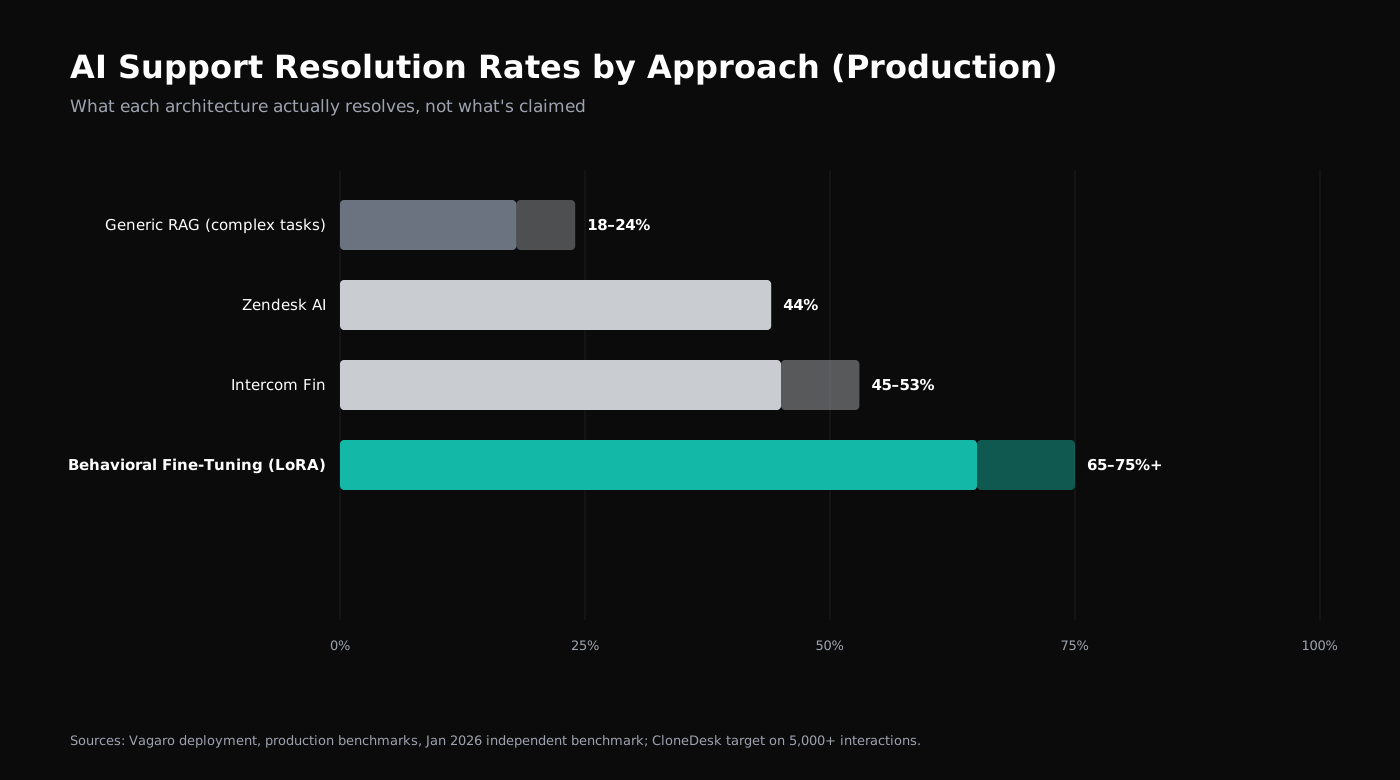
Production resolution rates diverge sharply by vendor and architecture: Zendesk AI logged 44% where it claims 80%, Intercom Fin runs 45–53% against a 70% claim, and generic RAG resolves just 18–24% on complex multi-step tasks. An independent January 2026 benchmark found AI agents fail those harder tasks 76 to 82% of the time. Behavioral fine-tuning on your own historical ticket data can push the rate to 65–75%+, but only if you have 5,000+ resolved interactions to train on. This is the cross-vendor benchmark — what every number in the market actually means, and how to measure your own.
Measured in production rather than in marketing decks, resolution rates diverge sharply by architecture — and behavioral fine-tuning is the only approach clearing the two-thirds mark.
How Resolution Rate Is Defined (And Why Vendor Numbers Are Misleading)
Before comparing any benchmark figures, you need to understand how "resolution rate" is calculated — because every vendor defines it differently, and every vendor's definition happens to make their product look better.
The most common vendor definition: a ticket is "resolved" if the conversation ends without a human agent picking it up. This sounds reasonable until you realize what it counts as a resolution:
The customer gave up and closed the chat window without getting an answer.
The customer received a confident but incorrect answer and didn't escalate because they didn't know it was wrong.
The customer submitted a second ticket through email after the AI failed them in chat — the chat session counts as "resolved" even though the issue was never fixed.
The AI responded with a generic knowledge-base article that didn't address the actual question, and the customer said "thanks" out of politeness before leaving.
The real definition
A ticket is genuinely resolved when the customer's issue is fully addressed — confirmed either by explicit customer feedback, a CSAT score above threshold, or the absence of a follow-up ticket on the same issue within 72 hours. Any metric that counts "no escalation" as a proxy for resolution is inflating the number.
The definitional gap explains most of the chasm between vendor claims and production reality. Zendesk's reported 80% automation rate measures "conversations handled without a human." Vagaro's documented production deployment measured actual first-contact resolution — and logged 44%. That 36-point gap isn't a bug; it's a measurement difference that vendors have no incentive to close.
"Vendors count a conversation as resolved the moment a human doesn't touch it. Customers count a conversation as resolved the moment their problem is actually solved. These are not the same thing."
When you evaluate AI support tools, insist on seeing resolution rate defined as: confirmed resolution within the same session, with no follow-up ticket on the same issue within 72 hours. Anything looser than that is a vanity metric.
2026 Benchmark Data: What AI Support Actually Resolves
Here is what the production and benchmark data actually shows across the major platforms and architectures as of early 2026:
Platform / Approach
Claimed Rate
Production Rate
Architecture
Data Source
Zendesk AI
80%
44%
RAG
Vagaro deployment
Intercom Fin
70%
45–53%
RAG
Production benchmarks
Generic RAG (complex tasks)
—
18–24%
RAG
Jan 2026 independent benchmark
Behavioral Fine-Tuning (LoRA)
—
65–75%+
Fine-tuning
CloneDesk target (5,000+ interactions)
Sources: Vagaro/Zendesk case study; Intercom Fin production benchmarks; January 2026 independent AI agent benchmark (complex enterprise tasks); Predibase fine-tuning case studies (Checkr, Convirza). As of May 2026.
The January 2026 independent benchmark is the most important data point in this table. It was run across enterprise support task types — not curated demos — and found that the best-performing AI agent across all vendors succeeded on complex multi-step tasks only 18–24% of the time. The other 76–82% were failures: wrong answers, incomplete resolutions, or outright hallucinations.
76–82%
failure rate on complex multi-step AI support tasks — independent January 2026 benchmark across enterprise deployments
The Zendesk and Intercom figures come from real deployments, not synthetic tests. Vagaro is a booking and business management platform with a high volume of account-related support — exactly the kind of real-world mix that exposes RAG's weaknesses. Their 44% documented rate against Zendesk's claimed 80% is the most direct evidence in the market that vendor claims don't survive contact with actual ticket queues.
Intercom Fin's 45–53% production range is drawn from third-party analysis of deployments across SaaS and e-commerce helpdesks. Intercom's own engineering team has acknowledged that the "well beyond 70%" ceiling requires a curated ticket queue with predominantly simple, single-turn interactions — not representative of a typical support operation.
Wondering what resolution rate your ticket queue can actually reach? CloneDesk previews accuracy on your historical data before going live.
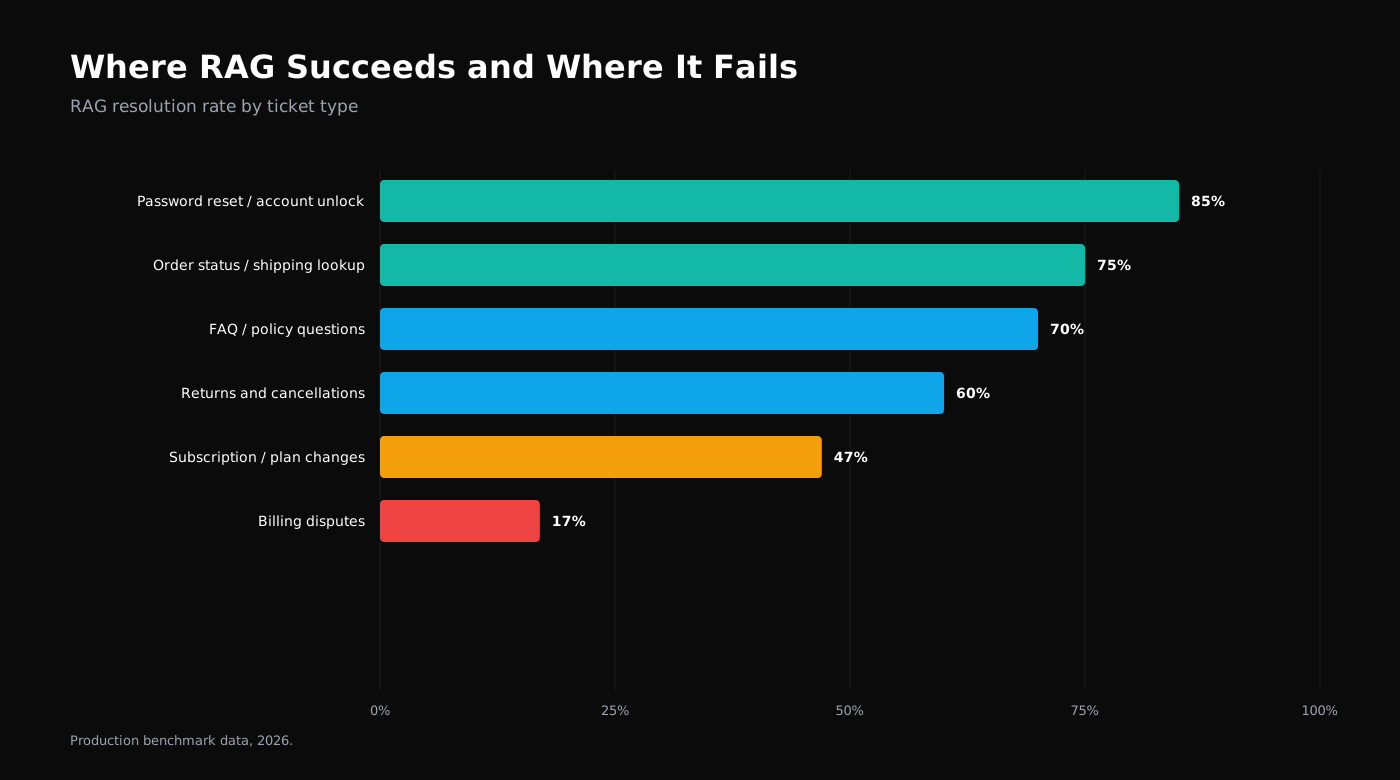
RAG handles simple, single-step tickets well and collapses on high-context ones — the failure is concentrated exactly where resolutions matter most to revenue.
Which Ticket Types AI Resolves vs. Fails
Resolution rate is not a single number — it's an average across very different ticket types. The average hides the real story: AI performs acceptably on a narrow slice of simple, high-frequency interactions, and collapses on everything else.
Ticket Type
RAG Resolution Rate
Why It Succeeds / Fails
Password reset / account unlock
80–90%
Single-step, clear action, no ambiguity
Order status / shipping lookup
70–80%
Structured data retrieval, defined response
FAQ / policy questions
65–75%
Works if documented; fails on edge cases
Returns and cancellations
55–65%
Policy-driven but context-dependent
Subscription / plan changes
40–55%
Multi-step, often requires account state
Billing disputes
17%
High context, financial stakes, low tolerance for errors
Sources: Industry chatbot resolution benchmarks (2025–2026); Jan 2026 independent benchmark (complex multi-step tasks); Forethought/Zendesk billing dispute analysis.
The pattern is consistent across every helpdesk dataset: the simpler and more transactional the ticket, the better AI performs. The more context, judgment, or multi-turn reasoning required, the worse it gets.
This creates a deceptive average. A helpdesk where 40% of tickets are password resets and order lookups will report an overall AI resolution rate of 60%+ — masking the fact that billing disputes and complex account issues, which drive the most churn when mishandled, are failing at 17–24%. Vendors report the average. Your customers experience the failures.
The multi-turn problem is structural
The single biggest driver of low resolution rates on complex tickets is RAG's inability to maintain context across turns. A customer describes a billing issue, the AI asks a clarifying question, the customer answers — and the RAG system re-retrieves context from scratch, losing the thread of what was already established. By message four in a complex conversation, the AI is effectively starting over. This is not a prompt engineering problem. It is an architecture problem.
Behavioral fine-tuning sidesteps it entirely: the model has seen thousands of multi-turn resolutions during training and has learned the patterns — which questions to ask when, how to maintain state in the response, when to escalate. That behavior is encoded in weights, not retrieved at inference time.
How to Calculate Your Own Baseline Resolution Rate
Before you can evaluate any AI vendor's numbers, you need to know your own baseline. Your current resolution rate — the percentage of tickets your existing system closes without human escalation — is the floor any AI tool must beat, not the ceiling it's measured against.
Baseline Resolution Rate Formula
Baseline Resolution Rate = (Tickets closed without human escalation ÷ Total tickets in period) × 100
Pull 90 days of closed tickets. Use the same 72-hour follow-up rule to define "without escalation."
Here's the step-by-step process to run this in Zendesk or Intercom in under 30 minutes:
Export 90 days of closed tickets. Filter to tickets with status "Solved" or "Closed." Include ticket ID, channel (chat, email, web), assignee type (bot vs. human), and whether a follow-up ticket was opened within 72 hours on the same issue.
Segment by assignee type. Separate tickets resolved exclusively by automation or bot versus tickets that required any human touch — even a single reply from a human agent counts as human-assisted.
Apply the 72-hour follow-up filter. Remove any "bot-resolved" ticket where the same customer opened a new ticket within 72 hours. These are false positives — the issue wasn't actually resolved.
Calculate the rate. Divide cleaned bot-resolved tickets by total ticket volume. This is your true current automation baseline.
Segment by ticket type. Run the same calculation for each of your top 5 ticket categories. This tells you where AI is already working and where there is headroom to improve.
Most teams running this exercise for the first time discover their real automation baseline is 15–25% — far below what their current AI tool's dashboard reports, because the dashboard counts any auto-response as a "resolution." That gap is where the opportunity lives.
"If your current AI tool reports 60% resolution and your honest calculation lands at 22%, you're not underperforming a good tool. You're accurately measuring a tool that was overclaiming."
CloneDesk shows you projected accuracy on your own historical data before any live traffic runs — not a synthetic benchmark, your data.
What 65–75% Resolution Rate Actually Means for Your Team
The number matters less than what it unlocks. A genuinely validated 65–75% resolution rate on a 10,000-ticket-per-month helpdesk means 6,500–7,500 tickets handled without human intervention — versus 2,000–2,500 at a real 22% baseline. That delta is where the ROI lives.
Tickets deflected/month
+4,500
Moving from 22% to 67% resolution on a 10K/month queue — the tickets your team no longer handles manually.
Cost at $0.99/resolution
$4,455
Per month for CloneDesk. Compare to $12–18/ticket for human-handled tickets — the same 4,500 tickets cost $54K–$81K with a human agent.
Agent capacity freed
3–5 FTE
At 30 tickets/agent/day, deflecting 4,500 tickets/month frees 3–5 full-time agent equivalents for complex escalations.
CSAT impact
+8–12pts
Response time drops to seconds on 65%+ of tickets. Speed alone drives CSAT improvement — before accounting for resolution quality.
The behavioral fine-tuning case studies from comparable production deployments validate the magnitude of these returns. Checkr, using fine-tuning via Predibase, achieved 90% accuracy at 5x lower cost than GPT-4 for high-volume classification. Convirza, running LoRA fine-tuning for call center analytics scoring, achieved better accuracy than OpenAI at 10x lower per-call cost. Neither of these is a cherry-picked pilot — they're production systems processing millions of interactions.
Checkr
Background check classification · Llama-3-8b fine-tuned via Predibase
Replaced GPT-4 with a fine-tuned open-source model for production classification at scale. 90% accuracy with dramatically lower inference latency. Predibase case study ↗
5×
cost reduction vs GPT-4
90%
production accuracy
Convirza
Call center analytics scoring · Llama-3-8b + LoRA fine-tuning via Predibase
Replaced OpenAI API calls with a LoRA-fine-tuned model for per-call scoring. Improved accuracy over OpenAI at 10x lower cost per call. Predibase case study ↗
10×
cost reduction vs OpenAI
+8%
accuracy improvement
The threshold that unlocks this range is 5,000+ resolved historical interactions. Below that, there isn't enough signal to learn the full range of your escalation patterns, edge cases, and ticket-type nuances. Above it, each additional resolved interaction improves the adapter's coverage of your specific support domain.
CloneDesk's pricing is $0.99 per automated resolution — no seat licenses, no platform fee, no contracts. The free tier covers 100 resolutions per month, enough to validate accuracy on a real subset of your queue before any spending commitment.
→ Vendor-claimed AI resolution rates (70–80%) consistently overstate production performance. Documented deployments show Zendesk AI at 44% and Intercom Fin at 45–53% in production.
→ An independent January 2026 benchmark found AI agents fail on complex multi-step support tasks 76–82% of the time.
→ Simple ticket types (password resets, order status) resolve at 80–90% with standard RAG. Complex tickets (billing disputes, multi-step troubleshooting) drop to 17–23%.
→ Behavioral fine-tuning on 5,000+ historical interactions targets 65–75%+ resolution — validated on your data before going live, not after.
→ Resolution rate is a lagging metric. Calculate your baseline: (tickets closed without escalation) ÷ (total tickets) — segment by ticket type to see where AI is and isn't working.
Frequently Asked Questions
A production-validated rate of 60–70% is strong for most helpdesks in 2026. Vendor claims of 70–80% rarely hold in production — documented deployments at Vagaro (Zendesk) logged 44% and Intercom Fin typically delivers 45–53% in production. Teams with 5,000+ resolved historical interactions using behavioral fine-tuning can target 65–75%+. Anything below your current unaided deflection baseline (typically 15–25%) is a regression, not an improvement.
Zendesk claims an 80% automation rate in marketing materials. A documented production deployment at Vagaro logged 44% actual resolution — a 36-point gap. The discrepancy exists because Zendesk counts any conversation that ends without human escalation as "resolved," including sessions where the customer gave up, received an inaccurate answer, or went on to submit a follow-up ticket through another channel.
Intercom Fin claims up to 70% resolution rate in sales materials. Production benchmarks show 45–53% in real deployments across SaaS and e-commerce helpdesks. Intercom's own engineering team has noted that "well beyond 70%" requires a carefully curated, low-complexity ticket queue — not representative of typical support operations with billing disputes, multi-step account issues, or edge-case escalations.
AI support resolves simple, single-turn tickets reliably: password resets (80–90%), order status lookups (70–80%), and FAQ policy questions (65–75%). Resolution rates drop sharply for billing disputes (17%), complex multi-step account issues (18–24%), and anything requiring multi-turn context retention. The January 2026 independent benchmark found 76–82% failure rates specifically on complex multi-step enterprise support tasks — the tickets with the highest customer impact.
Pull 90 days of closed tickets from your helpdesk. Filter to tickets resolved without any human agent reply, then remove any ticket where the same customer opened a follow-up ticket within 72 hours. Divide the cleaned count by total ticket volume and multiply by 100. This honest baseline — typically 15–25% for most teams — is the floor any AI tool must beat. Most vendor dashboards report a higher number because they count auto-replies as resolutions regardless of follow-up behavior.
Early Access
See Your Projected Resolution Rate Before Going Live
CloneDesk trains behavioral agents on your resolved ticket history — not generic documentation — and shows you projected accuracy on your own data before a single live ticket runs through it. Pricing starts at $0.99/resolution. Free tier: 100/month.