Quick answer — Intercom Fin resolution rate
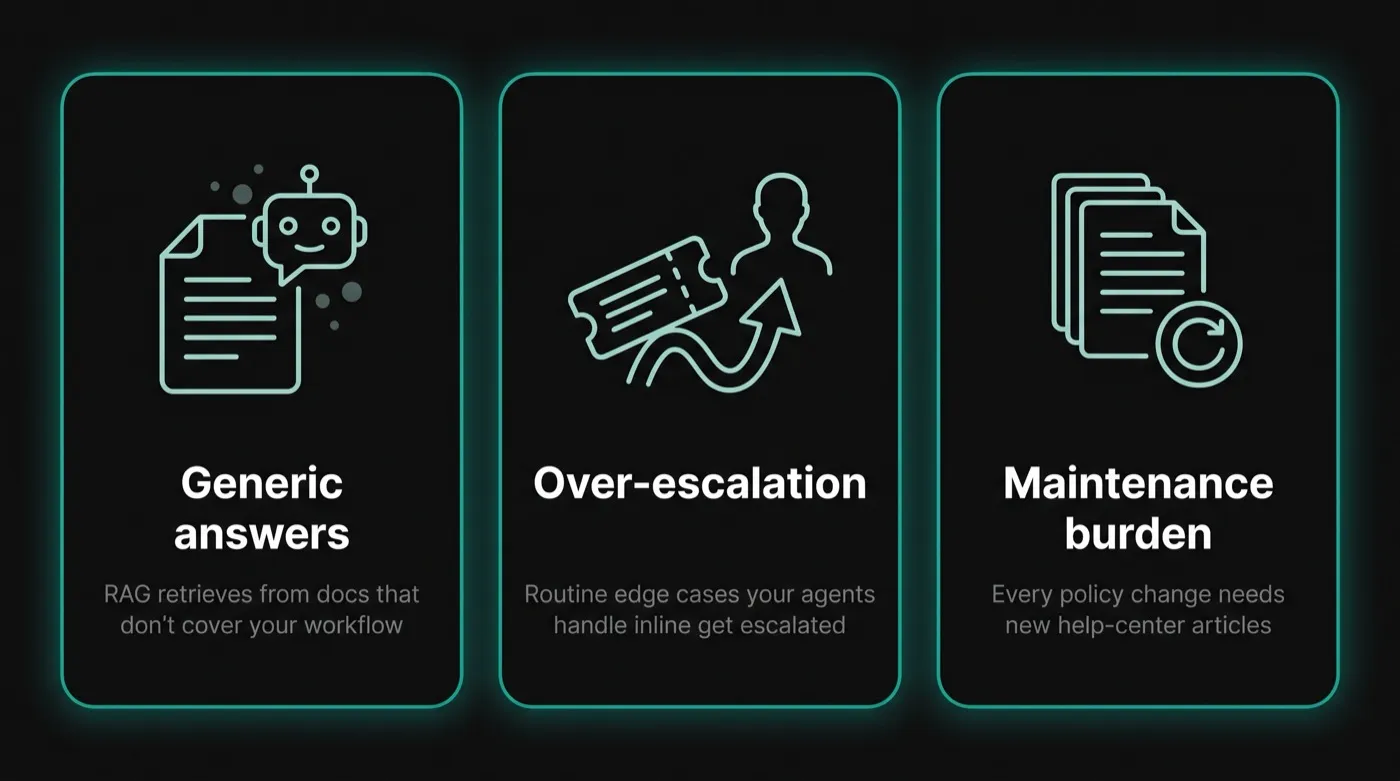
Intercom Fin achieves a 45–53% resolution rate in production, versus the 76% average Intercom markets — a 23–31 point gap. Fin gives generic answers on workflow-specific tickets (its #1 failure mode), escalates on tickets experienced agents resolve inline (#2), and requires continuous knowledge-base maintenance to stay accurate (#3). All three trace to the same architectural choice: Fin retrieves from your help center at query time — it doesn't learn from how your team has actually resolved tickets.
Comparing Fin to Zendesk AI? See Intercom vs Zendesk in 2026: the AI resolution gap — head-to-head on production resolution rates, pricing, and where each breaks down.
Intercom now markets a 76% average resolution rate for its AI agent, Fin. Production data from documented deployments shows 45–53% — a 23–31 point gap between what you're told to expect and what teams actually see. The shortfall isn't a configuration problem or a knowledge-base quality issue you can fix with more writing. It's a structural consequence of how Fin works.
Fin is built on RAG — retrieval-augmented generation. At inference time, it searches your help center for relevant articles and passes them to a language model to generate a response. The model has never seen how your team actually resolves tickets. It has only seen what you've written about how you think you resolve tickets. Those two things diverge significantly in most support organizations.
This article covers the three specific failure modes that drive that gap, what behavioral fine-tuning does architecturally differently, and when Fin is still the right choice.
What Resolution Rates Does Fin Actually Achieve?
(documented deployments)
(Intercom marketing)
Intercom Fin's production resolution rate is 45–53%, not the 76% Intercom markets. The gap isn't measurement noise — it's a structural consequence of how Fin handles complex, multi-step tickets that don't have a clean documentation match. Vendor-reported numbers come from benchmark customer cohorts (typically e-commerce or B2C with high-volume, low-variance ticket mixes); production deployments at B2B SaaS companies — where ticket variance is higher and edge cases are routine — land 23–31 points lower.
This matches the broader pattern across the category: independent reviews of production AI-agent deployments consistently report high failure rates on complex, multi-step tasks. Fin is not an outlier. The gap widens further on technical B2B support, where ticket variance is higher than e-commerce or consumer use cases and resolution often requires procedural judgment your agents carry in their heads.
If your current resolution rate sits in the 45–53% range, you are not under-configured. You are operating where RAG architecturally plateaus.
The same dynamic shows up across the broader AI helpdesk resolution-rate benchmark — Fin's gap is one instance of the structural pattern documented in why AI customer support fails. For teams already running Fin who can't immediately replace the stack, the operational playbook for reducing escalation rate is the right starting point.
Fin resolution rates by ticket type
The 45–53% overall figure is an average. The range by ticket type is much wider — Fin performs near its claimed rate on simple FAQ tickets, and well below 30% on complex or judgment-dependent ones:
| Ticket Type | Fin Resolution Rate | Why It Breaks Down |
|---|---|---|
| FAQ deflection (returns, how-to, password resets) | 60–70% | Strongest use case — clean doc coverage, low judgment required |
| Standard billing & account inquiries | 50–60% | Drops when exceptions or account-specific context is required |
| Procedural & workflow-specific tickets | 30–40% | Resolution logic lives in agent behavior, not documentation |
| Policy edge cases & one-time exceptions | 20–30% | Escalates — exception criteria aren't written down anywhere |
| Complex multi-turn / enterprise accounts | 15–25% | Requires relationship context + product history + account judgment |
Breakdown based on the 45–53% overall production average. Teams with high FAQ volume will see overall rates at the top of the range; B2B SaaS teams with complex queues will land at the bottom. If your current production rate sits in the 45–53% range, you are not under-configured — this is where RAG architecturally plateaus.
Does Fin Handle Complex Tickets?
No — complex tickets are where Intercom Fin breaks down hardest. Fin resolves an estimated 15–25% of complex multi-turn and enterprise-account tickets, versus 60–70% on simple FAQ deflection. A "complex" ticket here means anything that needs more than a documentation lookup: multi-step troubleshooting, policy exceptions, account-specific judgment, or a conversation that spans several turns and shifts intent partway through.
The reason is architectural, not a configuration gap. Fin retrieves from your help center at query time, so when resolution depends on context your agents carry in their heads — the customer's account history, an unwritten exception rule, the right de-escalation tone for a frustrated enterprise buyer — Fin has nothing to retrieve. It returns a plausible but generic answer, or it escalates to a human. As the table above shows, Fin's resolution rate falls steadily as complexity rises: procedural and workflow tickets land at 30–40%, policy edge cases at 20–30%, and complex multi-turn or enterprise tickets at 15–25%.
This is why teams with complex B2B support queues see overall production rates at the low end of the 45–53% range — the tickets that matter most, like high-value enterprise accounts, expansion signals, and compliance requests, are exactly the ones Fin handles worst. Behavioral fine-tuning closes this gap by learning complex-ticket resolution patterns directly from your historical resolved tickets, rather than retrieving from documentation that was never written for those cases.
Intercom Fin pricing per resolution (2025–2026)
Intercom Fin charges $0.99 per resolution as of 2025–2026, billed only when a conversation closes without human handoff. Intercom's definition of "resolution" is the same metric driving the 76% headline — meaning you pay full price on every conversation that closes, including the ones where Fin gave a generic, non-resolving answer that the customer abandoned.
Per-resolution pricing sounds aligned with outcomes but inherits the resolution-rate inflation problem. If 25–45% of "resolutions" don't actually resolve the customer's issue, you're paying $0.99 × every closed conversation regardless of whether the answer worked. For teams with 10,000+ monthly conversations, that can mean tens of thousands per month flowing through a metric that overstates actual customer success by ~25–35 percentage points — money paid on what is, by your own internal measurement, unresolved support.
CloneDesk's behavioral fine-tuning approach prices comparably ($0.99 per automated resolution) but measures resolution against the patterns your own top human agents follow — not against the vendor's broader "didn't escalate" definition. The unit economics improve as the resolution definition tightens.
For a complete breakdown of the cost difference between Fin's per-resolution model, Zendesk AI's per-seat pricing, and behavioral fine-tuning at 1k, 5k, and 20k monthly tickets, see the 2026 AI support agent pricing comparison. The architectural details of how behavioral fine-tuning differs from RAG at the model-weights level are in what behavioral fine-tuning actually does.
How Intercom Fin Actually Works
RAG in a support context
When a customer message arrives, Fin embeds the query and retrieves the most semantically similar content from your knowledge base — help articles, PDFs, connected URLs. It passes those documents as context to an underlying language model (GPT-4 or Claude), which generates a response based on what it found. The model itself has not learned anything about your business. It reads your docs at inference time, every time.
Fin's resolution rate — what Intercom reports as 76% — is measured against the full ticket queue at benchmark customers. The 45–53% range seen in production deployments reflects a different ticket mix: real queues weighted toward complex, multi-turn, and procedurally nuanced issues that RAG does not handle well.
The Three Failure Modes
1. Generic answers on workflow-specific tickets
The tickets Fin handles confidently are the ones where the answer lives in a help article: refund policy questions, password resets, shipping timelines, basic feature explanations. These are well-covered by a good knowledge base, and RAG retrieves them reliably.
The tickets Fin struggles with are the ones where the answer depends on how your team actually operates — not what's documented. Consider:
- A customer reporting an issue that affects their billing but wasn't caused by them — your team routinely applies a one-time credit in these cases, but that's a judgment call encoded in agent behavior, not a policy article
- An enterprise customer asking whether they can get an exception to your standard SLA — your team escalates immediately for accounts above a certain spend threshold, but that logic isn't in your help center
- A ticket where the customer is frustrated and the right move is a specific de-escalation approach your best agents use — tone calibration isn't documented anywhere
In all three cases, Fin retrieves the closest relevant article and generates a response from it. The response is coherent and often partially correct. But it's generic — it doesn't reflect the specific judgment your team would apply. The customer ends up escalating anyway, or replies with a follow-up that Fin can't resolve either.
Fin can only know what is written in your docs — not how your best agents actually behave on the tickets that matter most.
A concrete example: a customer writes in asking to process a refund on an order that was delayed by a fulfillment issue on your end. Your top agent knows the context — this account flagged a fulfillment problem in the previous ticket, your policy allows a one-time exception credit for documented delays, and the right move is to apply the credit and close without asking for proof. Fin retrieves the standard refund policy article (which requires proof of damage or incorrect item), finds no mention of exception credits, and responds with: "Please provide your order number and the reason for your refund request." The customer is already frustrated because this is their second ticket on the same issue. Now they're repeating themselves and being asked for documentation they shouldn't need.
The failure here isn't that the refund policy article is wrong. It's that the right resolution required knowing how your team applies that policy in practice — and that knowledge lives in your agents' judgment, not in any document Fin can retrieve.
2. Escalation on tickets experienced agents resolve inline
Fin escalates to a human agent when it detects that a ticket is outside what it can confidently handle. This is the right behavior — you'd rather have a clean handoff than a wrong answer. But the escalation threshold is calibrated against your knowledge base coverage, not your team's actual resolution capability.
The result: tickets your experienced agents routinely resolve in a single response get escalated. These are often your highest-value tickets — account management questions, enterprise-tier requests, complex billing disputes, policy exceptions. Fin's escalation rate on these ticket types is significantly higher than its overall average, which is why teams with complex B2B support queues see production rates at the low end of the 45–53% range.
This is not a Fin-specific flaw. It's an inherent consequence of RAG: the model can only pattern-match against retrieved documents. If the right resolution for a ticket requires knowing how your team makes exception decisions, and that knowledge isn't in a document, the model routes to a human. Every time.
In practice: a customer on an enterprise plan asks whether your team can accommodate a custom data export format for a compliance audit — something you've done manually for two of your largest accounts. Your experienced agents know immediately: this is an account management question that should go to the solutions team, flagged as a potential expansion signal (custom compliance work is a paid add-on in your roadmap). Fin sees a technical question it can't find in your documentation and escalates to the general support queue. The expansion signal is lost. The customer waits for a support agent when they needed an account manager. Your ops team later wonders why this account's renewal conversation started awkwardly.
At B2B SaaS companies where enterprise accounts represent a disproportionate share of revenue, this escalation pattern is one of the primary reasons production rates land at the low end of 45–53% — the ticket types that matter most are exactly the ones Fin handles worst.
3. The knowledge base maintenance burden
The third failure mode is operational rather than architectural — but it compounds the first two over time.
RAG is only as good as your knowledge base. Every time your product changes, your pricing updates, your policies evolve, or your team develops new resolution patterns, your help center has to be updated or Fin continues giving wrong answers based on outdated information. This isn't a one-time setup cost — it's ongoing maintenance that scales with your product complexity and team size.
In practice, most knowledge bases drift. A 2025 analysis of enterprise help centers found that a significant portion of articles are more than 12 months old, with outdated pricing, deprecated features, or superseded policies — none of which are flagged to Fin. The model retrieves them anyway and generates confident, incorrect responses.
A concrete example: in March your team changed its approach to handling subscription downgrades. The new flow leads with a retention offer (a 20% discount for 3 months) before confirming the downgrade — a change that took your team about two weeks to internalize. Your help center still documents the old flow. Every customer who asks Fin about downgrading gets the old confirmation-first response with no retention offer. No one sees an error. No Fin metric flags it as a failure — those conversations close as "resolved." You only discover it six weeks later when someone reviews a sample of downgrade transcripts and notices Fin has been leaving money on the table on every downgrade request since March. By then, the cost is real and unrecoverable.
The maintenance burden falls entirely on your team. Someone has to write the articles, keep them current, and structure them in a way that RAG retrieval can find and use them. This is work that generates no direct value — it only unlocks the value Fin was supposed to deliver automatically.
These three failure modes aren't unique to Fin — Zendesk AI plateaus at a documented 44% production resolution rate for the same architectural reasons. For the head-to-head comparison of Fin and Zendesk AI on production data, pricing, and where each breaks down, see Intercom vs Zendesk in 2026: the AI resolution gap.