CloneDesk — AI support agents trained on your resolved ticketsGet early access →
AI Customer Support
Why AI Customer Support Fails — And What Actually Fixes It
Chris CholetteFounder, CloneDeskFebruary 20268 min read
You've been sold an 80% resolution rate. You're seeing 44%.
The gap is not a bug in your Zendesk configuration. It's not your ticket data. It's a structural problem with how the entire category of AI customer support tools is built — and it gets worse the harder your tickets get.
This article explains why the gap exists, what the production data actually shows, and why behavioral fine-tuning closes it when retrieval-based AI can't.
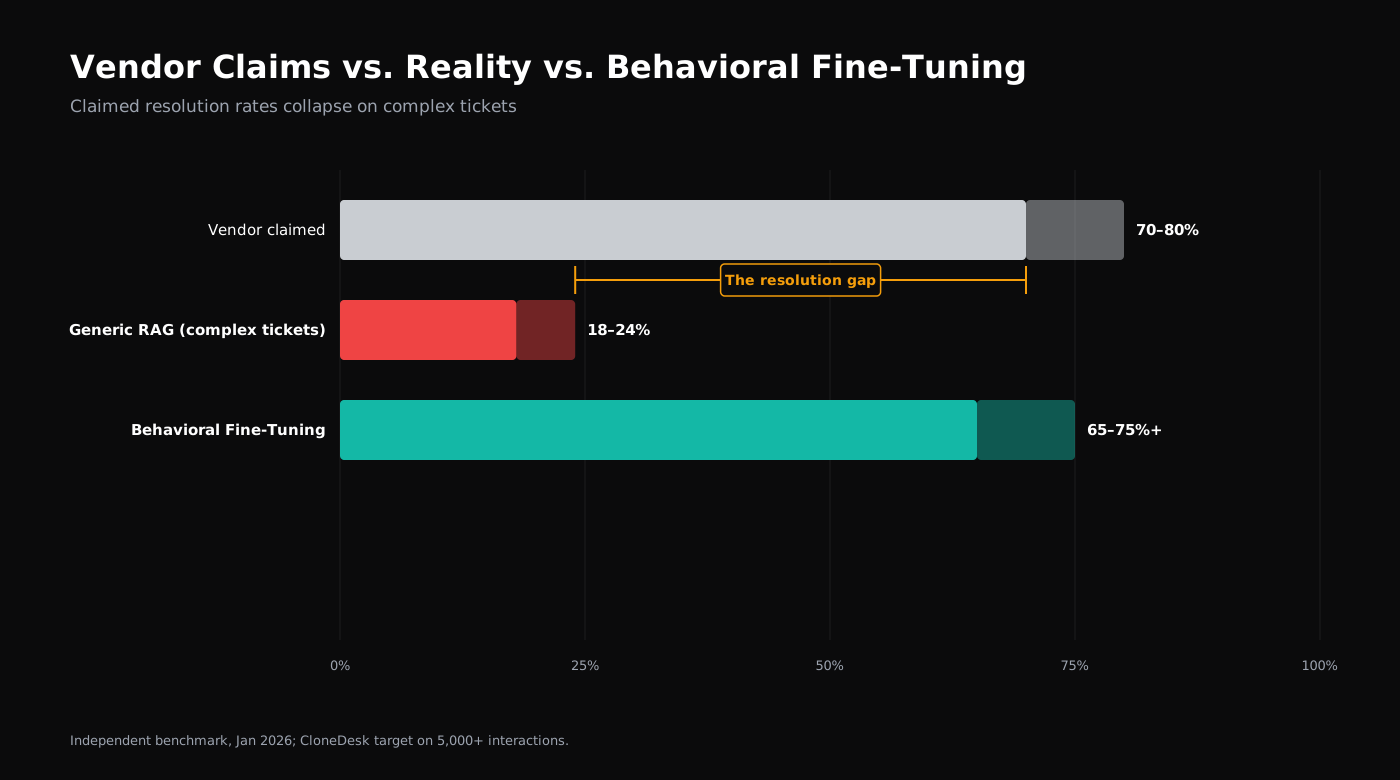
The gap between what vendors claim and what generic AI actually resolves on hard tickets is enormous — and it's the gap behavioral fine-tuning is built to close.
What AI Customer Support Resolution Rates Actually Look Like in 2026
Why it fails
AI customer support fails because most platforms use RAG — pulling answers from documentation at query time. RAG works on simple FAQ lookups but fails on complex tickets because it cannot retain context across a multi-turn conversation, cannot distinguish your company's escalation policy from a generic answer, and hallucinates on edge cases not covered in documentation.
Vendor marketing sites reference resolution rates of 50–80%. Production data tells a different story. An independent January 2026 benchmark across enterprise support tasks found AI agents fail on complex multi-step tickets 76 to 82 percent of the time — with a best-case success rate of 24 percent.
The per-vendor picture is no better:
Zendesk AI — Vagaro deployment
Claimed: 80% automation rate · Documented: 44% actual resolution
Complex multi-step enterprise support tasks — best-performing model across vendors
24%
success rate (best model)
Zendesk reports an 80 percent resolution rate in marketing materials; a documented Vagaro deployment logged 44 percent — a 36-point gap between vendor claim and production reality.
The definitional sleight-of-hand is part of the problem. Vendors count a ticket as "resolved" if the conversation ends without a human agent picking it up — even if the customer gave up, received an inaccurate answer, or submitted a second ticket through another channel. "No escalation" is not the same as "actually solved."
76–82%
failure rate on complex AI support tasks — independent January 2026 benchmark across enterprise deployments
Why RAG-Based AI Helpdesks Fail on Complex Tickets
The fundamental architecture of Zendesk AI, Intercom Fin, and most competitors is the same: RAG — retrieval-augmented generation. At query time, the system searches your knowledge base for relevant documents and passes them as context to a general-purpose language model. The model reads the docs and generates an answer.
This works well for simple lookups: "What's your return policy?" "Where is my order?" The answer is in a document. The retrieval finds it. Done.
It breaks on everything else:
Multi-turn conversations. RAG systems don't retain state. Each turn retrieves fresh context. The model doesn't remember what it said three messages ago — and neither does the customer's resolution path.
Edge cases not in documentation. If a ticket falls outside what's written down, the model hallucinates. Research puts the hallucination rate at 10–30% for complex queries — even with RAG grounding.
Brand voice and escalation logic. Your documentation describes what to do, not how your best agents actually do it. The model can't replicate tone, judgment calls, or the intuition a senior support rep has built over years of tickets.
Ticket complexity variance. Chatbot resolution rates range from 17% for billing issues to 58% for returns and cancellations. RAG performs fine on the easy 30% of tickets. It collapses on the complex 70% that actually matter to customers.
"The platforms optimize for the easy wins — routine tasks where AI already excels — and report those numbers as if they represent the full ticket queue. Complex task performance is buried in averages."
The result: 76% of enterprises implementing AI support maintain human-in-the-loop review specifically because they can't trust the AI to handle edge cases. 42% of enterprise AI initiatives were abandoned entirely in 2025 — with customer support among the highest-attrition categories.
CloneDesk uses behavioral fine-tuning to close the resolution gap. Join the early access list to get started.
The Resolution Gap Is Concentrated Where It Hurts Most
Not all ticket failure is equal. The resolution gap is biggest precisely on the tickets with the highest stakes for your customers:
Ticket Type
RAG-Based Resolution
Customer Impact
FAQ / order tracking
50–65%
Low — customer can self-serve
Returns / cancellations
58%
Medium — frustration if wrong
Billing disputes
17%
High — financial impact, churn risk
Complex multi-step issues
18–24%
Critical — escalation, churn, trust
Sources: Industry chatbot resolution benchmarks (2025–2026); Jan 2026 independent benchmark (complex multi-step tasks).
The easy tickets — FAQ, order status — are already being handled reasonably well by existing tools. The billing disputes and complex account issues where customers are most likely to churn if they don't get a real answer? That's exactly where RAG collapses.
How Behavioral Fine-Tuning Achieves 65–75%+ Resolution Where Generic AI Fails
Definition
LoRA behavioral fine-tuning (Low-Rank Adaptation) encodes decision patterns directly into model weights by training on your actual resolved interactions — not documentation. Unlike RAG systems that retrieve answers from a knowledge base at inference time, a behaviorally fine-tuned model has learned how your best agents handle tickets: the tone they use, when they escalate, how they resolve edge cases. No retrieval at inference time. No knowledge-base maintenance. The behavior is baked in.
The architecture difference is fundamental, not incremental. RAG asks: what does the documentation say about this question? Behavioral fine-tuning asks: how has our best agent historically resolved this type of ticket?
The model learns from 6–18 months of your resolved interactions — including the edge cases, the escalation decisions, the two-sentence responses that your senior agents write from experience, not from a help article. Those patterns are encoded into a LoRA adapter, a lightweight addition to the base model that survives inference without a retrieval call.
Production deployments using comparable behavioral fine-tuning show what's possible at scale:
Checkr
Background check classification · Llama-3-8b-instruct via fine-tuning
Replaced GPT-4 with a fine-tuned open-source model for high-volume classification. Achieved 90% accuracy — with dramatically lower inference cost and faster response times. Predibase case study ↗
Replaced OpenAI API calls for evaluation scoring with a LoRA-fine-tuned model. Achieved better accuracy than OpenAI at 10x lower per-call cost. Predibase case study ↗
10×
cost reduction vs OpenAI
+8%
accuracy improvement
The common thread: fine-tuned models don't just match general-purpose models on narrow tasks — they outperform them, because they've learned the specific patterns that matter for the task. A model that has seen ten thousand of your billing tickets handles the next billing ticket better than a model that's read your billing FAQ.
CloneDesk trains on your resolved tickets, not your docs. Early access available for teams with 5,000+ historical interactions.
Vendor Claims vs Reality vs Behavioral Fine-Tuning
Here's how the resolution rate picture stacks up across the market:
Tool
Claimed Rate
Documented Rate
Architecture
Zendesk AI
80%
44%
RAG
Intercom Fin
76%
45–53%
RAG
Helply
65% guaranteed
70–91%
RAG + actions
CloneDesk
75%+ target
Early access
Behavioral fine-tuning (LoRA)
Documented rates from publicly available case studies and independent benchmarks. CloneDesk accuracy is previewed on your historical ticket holdout before going live. As of February 2026.
The CloneDesk row is intentionally different: we don't publish a universal resolution rate, because your resolution rate depends on your ticket complexity mix, your data volume, and your escalation patterns. What we do instead is show you the projected accuracy on your actual data before a single live ticket runs through it.
How CloneDesk Works
The architecture is different from the ground up. Rather than connecting to a knowledge base and retrieving at inference time, CloneDesk trains a behavioral model directly from your historical resolved interactions.
01
Connect your helpdesk
Connect Zendesk or Intercom in under 10 minutes. CloneDesk ingests your resolved interactions — typically 6–18 months of tickets. No migration, no rip-and-replace.
02
Behavioral training
CloneDesk extracts resolution patterns from your historical interactions: how your best agents phrase responses, when they escalate, how they handle edge cases. A LoRA adapter is trained on these patterns — completing in 1–6 hours depending on data volume.
03
Accuracy preview on your data
Before going live, CloneDesk runs the trained adapter against a holdout set of your historical tickets and shows projected resolution accuracy. You see the number on your data — not benchmark data — before any live traffic moves.
04
Deploy and continuously improve
Behavioral agents go live inside your existing Zendesk or Intercom workflow. Resolution rate, CSAT, and escalation patterns are tracked in real time. The model continues learning from new resolved interactions.
Pricing: $0.99 per automated resolution. Free tier includes 100 resolutions per month. Early access is available now — we're onboarding teams with 5,000+ resolved interactions first.
Early Access
Fix Your Resolution Rate Before Your Competitors Do
CloneDesk trains behavioral agents from your historical ticket queue — not your documentation. Early access is open now. Teams with 5,000+ resolved interactions get priority onboarding.