AI Support Agent Pricing in 2026: Per-Resolution vs Per-Seat vs Behavioral Fine-Tuning
Chris CholetteFounder, CloneDeskMay 20269 min read
There are three distinct pricing models for AI support agents in 2026: per-seat add-ons (you pay per human agent on your team), per-resolution (you pay for each ticket the AI closes), and behavioral fine-tuning (per-resolution, but the AI resolves significantly more). Most pricing comparisons only cover the first two — and that gap in the analysis leads to some expensive surprises at scale.
This is a complete breakdown of what each model actually costs, how the numbers change at different ticket volumes, and the incentive problem hidden in per-resolution billing that most evaluations don't surface.
The Three Models at a Glance
Model 1
$50
per agent / per month (add-on)
Zendesk Advanced AI
Flat cost regardless of resolution volume. Requires existing Zendesk Suite seat.
Model 2
$0.99–$2.00
per AI-resolved conversation
Intercom Fin · Zendesk AI Agent · Agentforce
Costs scale directly with AI usage. No headcount dependency.
Model 3
$0.99
per resolution · higher resolution rate
CloneDesk (behavioral fine-tuning)
Same per-resolution rate as Fin, but trained on ticket history — not your knowledge base.
Free tier
100
free resolutions / month
CloneDesk
No contract. No credit card to start. Scales at $0.99/resolution after.
Per-Seat Add-On: Zendesk Advanced AI
Zendesk's AI layer is priced as an add-on to existing Suite seats at approximately $50 per agent per month. This is a flat cost — it doesn't change based on how many tickets the AI resolves or how many customers it handles. For large teams with high ticket volume, this is the most favorable structure. For small teams or teams with variable volume, you're paying whether the AI is busy or idle.
What the $50 add-on buys: AI-powered triage and routing, macro suggestions for human agents, and the Zendesk AI Agent (bot) for automated resolution. The bot capability uses RAG over your knowledge base and performs at roughly 44% resolution in documented production deployments — against Zendesk's marketed 80%.
Total Zendesk cost example
A 20-agent team on Zendesk Suite Growth (~$115/agent/month) adding Advanced AI: $115 + $50 = $165/agent/month = $3,300/month total. The AI add-on is 30% of the total bill. If that team handles 10,000 tickets/month and the AI resolves 44%, they're paying roughly $0.75 per AI resolution — not bad at scale, very expensive if volume drops.
Per-Resolution: Intercom Fin, Zendesk AI Agent, Agentforce
Per-resolution pricing charges for each conversation the AI closes without human escalation. The rates differ significantly by vendor:
Intercom Fin: ~$0.99 per resolution
Zendesk AI Agent (standalone bot, not the add-on): ~$1.00 per resolution
Salesforce Agentforce: $2.00 per conversation — the most expensive model in the market
The appeal of per-resolution pricing is straightforward: you pay for outcomes, not headcount. A team of 5 agents pays the same per-resolution rate as a team of 500. For smaller organizations or teams with variable ticket volume, this is genuinely better than a per-seat model that charges flat regardless of usage.
The catch is that costs scale directly and linearly with AI usage. At low volume this is fine. At 20,000 AI-resolved tickets per month, you're paying $19,800 to Fin — more than most teams' entire Zendesk seat budget. And unlike the per-seat model, there's no natural ceiling.
Same $0.99/resolution as Fin — but trained on your tickets, not your docs. 100 free resolutions to start.
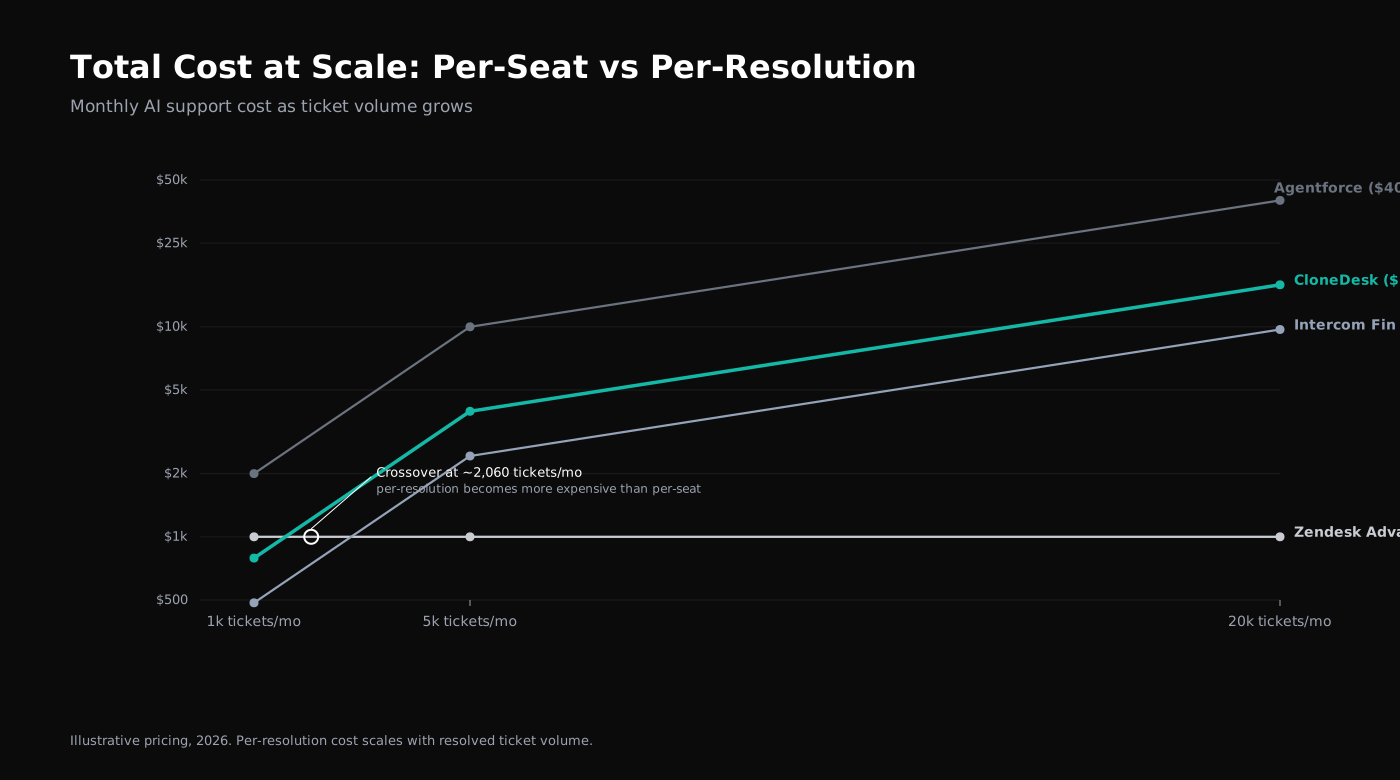
Per-resolution pricing looks cheaper at low volume, but crosses over per-seat pricing as your ticket count climbs — the crossover point is where the model you chose starts costing you.
Total Cost at Scale: A Side-by-Side
These numbers use a 20-agent team as the per-seat baseline. Resolution rates use documented production figures: 44% for Zendesk AI, 49% for Fin (midpoint of 45–53%), 80% for behavioral fine-tuning (conservative for teams with 5,000+ resolved interactions).
Vendor / Model
1,000 tickets/mo
5,000 tickets/mo
20,000 tickets/mo
Zendesk Advanced AI (per-seat, 20 agents)
$1,000 flat
$1,000 flat
$1,000 flat
Intercom Fin (per-resolution, 49% rate)
$485
$2,426
$9,702
Salesforce Agentforce ($2.00/conversation)
$2,000
$10,000
$40,000
CloneDesk behavioral fine-tuning (80% rate)
$792
$3,960
$15,840
Zendesk figure is add-on cost only, not base seat cost. Fin and CloneDesk figures are AI resolution costs only. Resolution rates from documented production data. Agentforce charges per conversation regardless of resolution outcome.
A few things stand out in this comparison. At low volume (1,000 tickets/month), Fin is the cheapest option and Agentforce is wildly expensive. At high volume (20,000 tickets/month), the Zendesk per-seat model becomes the cheapest by a wide margin — $1,000 flat versus $9,702 for Fin on the same ticket load. The crossover point where Fin becomes more expensive than Zendesk's per-seat add-on is roughly 1,020 resolutions per month for a 20-agent team.
The CloneDesk behavioral fine-tuning row looks more expensive than Fin in absolute terms at every volume — but that's because it's resolving more tickets. At 5,000 tickets per month, Fin resolves 2,450 and CloneDesk resolves 4,000. The cost per ticket deflected from a human agent is roughly $0.99 either way. What you're comparing is 49% deflection at $2,426 versus 80% deflection at $3,960 — and the 31 additional percentage points that stay off the human queue.
The Incentive Problem in Per-Resolution Pricing
Per-resolution pricing has a structural misalignment that doesn't show up on the rate card: your vendor's revenue grows when your AI handles more tickets. That's fine as long as your ticket volume is stable. But support organizations that are doing their jobs well work to reduce ticket volume over time — through better product documentation, proactive communication, and identifying root causes of common issues.
Per-resolution pricing makes your vendor's revenue depend on your ticket volume staying high. Your goals are not fully aligned.
This plays out in subtle ways. A vendor incentivized by resolution count has less motivation to help you identify the upstream product issues that would eliminate entire ticket categories. Features that reduce inbound volume — proactive nudges, better onboarding, improved error messaging — don't appear in their product roadmap because they shrink the addressable resolution pool.
This isn't a criticism of any specific vendor — it's a consequence of the pricing model. Per-resolution billing is not inherently bad (it aligns short-term costs with short-term outcomes), but it's worth understanding the incentive structure before signing a multi-year contract.
What to Ask Before Signing
Regardless of pricing model, these questions expose the actual cost of any AI support deployment:
How do you define "resolution"? Every vendor counts conversations that close without human escalation — including cases where the customer gave up, received a wrong answer, or filed a second ticket elsewhere. Ask for the definition in writing.
What's the resolution rate on my specific ticket mix? Vendor-cited rates are averages across diverse customer bases. Ask for accuracy estimates on your historical ticket types specifically — or run a pilot before committing.
What happens when my volume spikes? Per-resolution billing can produce surprise invoices during incident periods when ticket volume doubles or triples. Ask about caps or smoothing mechanisms.
Is there a minimum commitment? Several vendors require 12-month contracts. Understand what you're locked into if the production resolution rate underdelivers.
What does the knowledge base maintenance commitment look like? RAG-based tools require ongoing investment in keeping your help center current. This is a real labor cost that doesn't appear in the pricing comparison.
Which Model Is Right for Your Team
Per-seat add-on (Zendesk AI) if: you're already on Zendesk with no plans to migrate, your team is larger than 15–20 agents, and your ticket volume is consistently high (1,000+ AI-resolvable tickets per month). The flat cost structure becomes favorable at scale and predictable for budgeting.
Per-resolution (Intercom Fin or Zendesk AI Agent) if: your ticket volume is low or variable, you're already on Intercom, or you want to start small without a large fixed monthly commitment. Set a budget cap and monitor costs as volume grows.
Behavioral fine-tuning (CloneDesk) if: your support queue involves procedural judgment, policy edge cases, or workflows that live in agents' heads rather than your documentation — and your team has at least 3,000–5,000 historical resolved interactions to train from. The same per-resolution rate delivers significantly more deflection.
Frequently Asked Questions
How much does Intercom Fin cost?
Intercom Fin charges approximately $0.99 per resolution. A resolution is any conversation that closes without escalating to a human — including cases where the customer gave up or received an incomplete answer. At 1,000 AI-resolved tickets per month, that's roughly $990. At 5,000 resolutions per month, approximately $4,950. Fin requires an active Intercom subscription on top.
How much does Zendesk AI cost?
Zendesk AI is sold as an add-on at approximately $50 per agent per month on top of existing Suite seats. A 20-agent team pays $1,000/month extra. Zendesk also offers a standalone AI Agent bot at approximately $1.00 per resolution — separate from the per-seat add-on. The two are different products with different pricing structures that can be confusing to compare.
How much does Salesforce Agentforce cost?
Salesforce Agentforce is priced at $2.00 per conversation — the most expensive per-interaction rate in the market. It charges per conversation regardless of resolution outcome, which is distinct from the per-resolution model used by Fin and others. At 5,000 conversations per month, that's $10,000. Agentforce also requires Salesforce Service Cloud as the underlying platform.
What is the problem with per-resolution pricing?
Per-resolution pricing creates a misalignment: your vendor earns more when your AI resolves more tickets. This means reducing your total ticket volume — the goal of a well-run support org — also reduces your vendor's revenue. It doesn't make the vendor adversarial, but their roadmap priorities and your cost-reduction goals aren't fully aligned. This is worth understanding before committing to a multi-year per-resolution contract.
Which AI support pricing model is best?
Per-seat is best for large teams with consistently high volume already on Zendesk. Per-resolution is best for smaller teams, variable-volume teams, or those on Intercom. Behavioral fine-tuning is best for teams whose support involves complex judgment calls not covered in documentation — the higher resolution rate means more value at the same per-resolution price point.
$0.99/Resolution. Trained on Your Tickets, Not Your Docs.
CloneDesk uses behavioral fine-tuning to build agents from your resolved ticket history. 100 free resolutions per month. No contracts. See projected accuracy on your data before going live.